Wednesday, June 18, 2008

Tintagel War Memorial, Cornwall.

Tintagel War Memorial on the North coast of Cornwall, England.


A full list of the dead on the memorial can be found at tintagelweb.co.uk


The Tintagel War Memorial contains the name of one soldier who fought with the Australian Imperial force, Private Herbert Goodman, 28th Battalion, AIF.

Private Herbert Goodman enlisted on 9th September 1915. He was the son of John and Elizabeth J Goodman formerly of Treknow, and had arrived in Australia 5 years earlier at the age of 14.

His occupation on his enlistment is given as a farm-hand.

He embarked from Fremantle, Western Australia, on board HMAT A7 Medic on 18 January 1916


He was killed in Action on 3rd-6th November 1916 at Fleurs, France.

He is buried in Warlencourt British Cemtery (Plot IV, Row C, Grave No. 14), France, aged 20.

Tuesday, June 17, 2008

Villers-Bretonneux Military Cemetery

VILLERS-BRETONNEUX MILITARY CEMETERY was made after the Armistice when graves were brought in from other burial grounds in the area and from the battlefields.


Plots I to XX were completed by 1920 and contain mostly Australian graves, almost all from the period March to August 1918. Plots IIIA, VIA, XIIIA and XVIA, and Rows in other Plots lettered AA, were completed by 1925, and contain a much larger proportion of unidentified graves brought from a wider area. Later still, 444 graves were brought in from Dury Hospital Military Cemetery.


The following were among the burial grounds from which British graves were taken to Villers-Bretonneux Military Cemetery.

CARD COPSE CEMETERY, MARCELCAVE, on the road to Fouilloy, where 35 Australian soldiers were buried by the 2nd Australian Division in July and August, 1918.

DURY HOSPITAL MILITARY, CEMETERY, under the wall of the Asylum near the West side of the Amiens-Dury road. From August, 1918, to January, 1919, this building was used intermittently by British medical units, and a cemetery was made next to an existing French Military Cemetery. The British cemetery contained the graves of 195 Canadian and 185 United Kingdom soldiers and airmen; 63 Australian soldiers; one man of the Cape Auxiliary Horse Transport Corps; and one French and one American soldier.

HIGH CEMETERY, SAILLY-LE-SEC, on the road to Ville-sur-Ancre, where 18 United Kingdom and eleven Australian soldiers were buried in June-August, 1918.

KANGAROO CEMETERY, SAILLY-LE-SEC (on the Ville-sur-Ancre road, but nearer Sailly), where 13 Australian soldiers were buried by the 41st Battalion in March-April, 1918, and 14 of the 58th (London) Division by their comrades in August, 1918.

LAMOTTE-EN-SANTERRE COMMUNAL CEMETERY EXTENSION. The village was captured by Australian troops on the 8th August, 1918, and the Extension contained the graves of 56 Australian and twelve United Kingdom soldiers who fell in August and September.

LA NEUVILLE-LES-BRAY COMMUNAL CEMETERY, containing the grave of one Australian soldier who fell in August, 1918.

LE HAMELET BRITISH CEMETERY (behind the Church), containing the graves of 25 Australian soldiers who fell in April-July, 1918; and the COMMUNAL CEMETERY EXTENSION, in which 27 Australian soldiers and one from the United Kingdom were buried in July and August, 1916.

MIDWAY CEMETERY, MARCELCAVE, 1,500 yards North-West of Marcelcave Church, made by the Canadian Corps and containing the graves of 53 Canadian and three United Kingdom soldiers who fell in August, 1918.

VAUX-SUR-SOMME COMMUNAL CEMETERY, containing three Australian graves of March-April, 1918, and two United Kingdom of 1916 and 1917; and the EXTENSION, made in May-August, 1918, and containing the graves of 130 Australian soldiers and 104 soldiers (mainly 58th Division and Artillery) and one airman from the United Kingdom.
WARFUSEE-ABANCOURT COMMUNAL CEMETERY EXTENSION, in which five Australian soldiers were buried by the 12th Australian Field Ambulance in August, 1918. There are now 2,142 Commonwealth servicemen of the First World War buried or commemorated in this cemetery. 609 of the burials are unidentified but there are special memorials to five casualties known or believed to be buried among them, and to 15 buried in other cemeteries whose graves could not be found on concentration. The cemetery also contains the graves of two New Zealand airmen of the Second World War.

Villers-Bretonneux became famous in 1918, when the German advance on Amiens ended in the capture of the village by their tanks and infantry on 23 April. On the following day, the 4th and 5th Australian Divisions, with units of the 8th and 18th Divisions, recaptured the whole of the village and on 8 August 1918, the 2nd and 5th Australian Divisions advanced from its eastern outskirts in the Battle of Amiens.


Both cemetery and memorial were designed by Sir Edwin Lutyens.


Monday, June 16, 2008

Villers Bretonneux, The Australian National Memorial - Part IV

Photographs of the Australian National Memorial.


The Entrance


The Memorial in the distance.


Towards the Cross of Sacrifice.


The Cross of Sacrifice.


The Australian National Memorial


The Inscription reads :

"To the Glory of God and in memory of the Australian Imperial Force in France and Flanders 1916-1918
And of eleven thousand who fell in France and have no know grave. "


Inside the Memorial, with a map of the Austrialian Divisional Memorials.


Looking down from the Top of the Memorial.


The side of the Memorial.


A Bronze Plaque explaining the Australian involvement in France and Flanders.


It reads:

"Australia erected its national war memorial here to commemorate the nations feat of arms in France and Belgium during the war. The memorial also records and honours 10,982 Australian dead who have no known grave and died in France (other than at Fromelles). The national memorial with its 32 metre tower. Overlooks many of the battlefields in which Australians fought including those to the north around Dernancourt and south beyond Villers Bretonneux.
The memorial is located on a hill from which the Australians and British repulsed German advances on Villers Bretonneux on 24 April 1918.The memorial was built by the commonwealth war graves commission and unveiled in 1938 by King George VI - during 1940 French forces briefly held the advancing Germans in this area, signs of the damage done by German artillery can still be seen today. Separate from the memorial is the cemetery, which was made after the 1918 armistice. Graves from other burial sites and the battlefield were concentrated here. Men from many nations lie here in peace.
Their sacrifice is not forgotten."

Friday, June 13, 2008

Villers Bretonneux, The Australian National Memorial - Part III

This report in the British Nursing Journal in August 1938 page 199, recalls the King and Queen unveiling the Australian War Memorial.


The Queen placing a Flanders poppy from her bouquet on the Australian Memorial after it had been unveiled by the King.


"THE KING’S TRIBUTE TO AUSTRALIAN GALLANTRY.

On July 22nd, the King stood with the Queen and President Lebrun, beside him, when on hallowed ground at Villers-Bretonneux he unveiled the Australian War Memorial-ground hallowed for all time by the heroism of Australia’s soldiers. The ceremony was deeply impressive. At the close of the religious service the King laid a wreath of Flanders poppies at the foot of the memorial. The Queen stepped forward alone and placed a single poppy on the wreath of the King.
After touching ceremonies, from high in the topmost platform of the tower came the mournful wail of bugles -in lamentation for Australia’s dead - the “ Last Post ” and then ‘‘ Reveille ” rang out."


For more information on the Memorial and the unveiling go to: Australians on the Western Front.

Wednesday, June 11, 2008

Villers Bretonneux, The Australian National Memorial - Part II

Views of the surrounding countryside from the Australian National Memorial covering the ground fought over in 1918.


The view looking north towards Fouilloy & Corbie


The view looking east towards Le Hamel & Sailly-le-Sac and ultimately many miles away in the distance Pozieres.


The view from the National Memorial looking south towards Villers-Bretonneux.


To finish off the view over the cemetery west towards Amiens

Photos: Roger Stoakley at: rjstoakley@btopenworld.com

Monday, June 09, 2008

Villers Bretonneux, The Australian National Memorial - Part 1


The Australian National Memorial at Villers Bretonneux erected to commemorate all Australian soldiers who fought in France and Belgium during the First World War, to their dead, and especially to those of the dead whose graves are not known.

The 10,700 Australian servicemen actually named on the memorial died in the battlefields of the Somme, Arras, the German advance of 1918 and the Advance to Victory.

The memorial was unveiled by King George VI in July 1938.


Villers Bretonneux became famous in 1918, when the German advance on Amiens ended in the capture of the village by their tanks and infantry on 23 April. On the following day, the 4th and 5th Australian Divisions, with units of the 8th and 18th Divisions, recaptured the whole of the village and on 8 August 1918, the 2nd and 5th Australian Divisions advanced from its eastern outskirts in the Battle of Amiens.


Villers Bretonneux Military Cemetery was made after the Armistice when graves were brought in from other burial grounds in the area and from the battlefields. Plots I to XX were completed by 1920 and contain mostly Australian graves, almost all from the period March to August 1918. Plots IIIA, VIA, XIIIA and XVIA, and Rows in other Plots lettered AA, were completed by 1925, and contain a much larger proportion of unidentified graves brought from a wider area. Later still, 444 graves were brought in from Dury Hospital Military Cemetery.


Photos: Roger Stoakley at: rjstoakley@btopenworld.com

Friday, June 06, 2008

The first night in a Plugstreet trench

The book Bullets & Billets by Bruce Bairnsfather, gives a fantastic account of Bruce’s first night in a real trench in Belgium. This was a trench of 1914 and describes how uncomfortable and awful it must have been in those early days on the Western Front.


THOSE PLUGSTREET TRENCHES

“An extraordinary sensation—the first time of going into trenches. The first idea that struck me about them was their haphazard design. There was, no doubt, some very excellent reason for someone or other making those trenches as they were; but they really did strike me as curious when I first saw them.

A trench will, perhaps, run diagonally across a field, will then go along a hedge at right angles, suddenly give it up and start again fifty yards to the left, in such a position that it is bound to cross the kitchen-garden of a shattered chateau, go through the greenhouse and out into the road. On getting there it henceforth rivals the ditch at the side in the amount of water it can run off into a row of dug-outs in the next field. There is, apparently, no necessity for a trench to be in any way parallel to the line of your enemy; as long as he can't shoot you from immediately behind, that's all you ask.

It was a long and weary night, that first one of mine in the trenches. Everything was strange, and wet and horrid. First of all I had to go and fix up my machine guns at various points, and find places for the gunners to sleep in. This was no easy matter, as many of the dug-outs had fallen in and floated off down stream.

In this, and subsequent descriptions of the trenches, I may lay myself open to the charge of exaggeration. But it must be remembered that I am describing trench life in the early days of 1914, and I feel sure that those who had experience of them will acquit me of any such charge.

To give a recipe for getting a rough idea, in case you want to, I recommend the following procedure. Select a flat ten-acre ploughed field, so sited that all the surface water of the surrounding country drains into it. Now cut a zig-zag slot about four feet deep and three feet wide diagonally across, dam off as much water as you can so as to leave about a hundred yards of squelchy mud; delve out a hole at one side of the slot, then endeavour to live there for a month on bully beef and damp biscuits, whilst a friend has instructions to fire at you with his Winchester every time you put your head above the surface.

Well, here I was, anyway, and the next thing was to make the best of it. As I have before said, these were the days of the earliest trenches in this war: days when we had none of those desirable "props," such as corrugated iron, floorboards, and sand bags ad lib.

When you made a dug-out in those days you made it out of anything you could find, and generally had to make it yourself. That first night I was "in" I discovered, after a humid hour or so, that our battalion wouldn't fit into the spaces left by the last one, and as regards dug-outs, the truth of that mathematical axiom, "Two's into one, won't go," suddenly dawned on me with painful clearness. I was faced with making a dug-out, and it was raining, of course. (Note.—Whenever I don't state the climatic conditions, read "raining.") After sloshing about in several primitive trenches in the vicinity of the spot where we had fixed our best machine-gun position, my sergeant and I discovered a sort of covered passage in a ditch in front of a communication trench. It was a sort of emergency exit back from a row of ramshackle, water-logged hovels in the ditch to the communication trench. We decided to make use of this passage, and arranged things in such a way that by scooping out the clay walls we made two caves, one behind the other. The front one was about five yards from the machine gun, and you reached the back cave by going through the outer one. It now being about 11 p.m., and having been for the last five hours perpetually on the scramble, through trenches of all sorts, I drew myself into the inner cave to go to sleep.

This little place was about 4 feet long, 3 feet high, and 3 feet wide. I got out my knife, took a scoop out of the clay wall, and fishing out a candle-end from my pocket, stuck it in the niche, lit it and a cigarette. I now lay down and tried to size up the situation and life in general.

Here I was, in this horrible clay cavity, somewhere in Belgium, miles and miles from home. Cold, wet through and covered with mud. This was the first day; and, so far as I could see, the future contained nothing but repetitions of the same thing, or worse.

Nothing was to be heard except the occasional crack of the sniper's shot, the dripping of the rain, and the low murmur of voices from the outer cave.

In the narrow space beside me lay my equipment; revolver, and a sodden packet of cigarettes. Everything damp, cold and dark; candle-end guttering. I think suddenly of something like the Empire or the Alhambra, or anything else that's reminiscent of brightness and life, and then—swish, bang—back to the reality that the damp clay wall is only eighteen inches in front of me; that here I am—that the Boche is just on the other side of the field; and that there doesn't seem the slightest chance of leaving except in an ambulance.

My machine-gun section for the gun near by lay in the front cave, a couple of feet from me; their spasmodic talking gradually died away as, one by one, they dropped off to sleep. One more indignant, hopeless glare at the flickering candle-end, then I pinched the wick, curled up, and went to sleep.

A sudden cold sort of peppermint sensation assailed me; I awoke and sat up. My head cannoned off the clay ceiling, so I partially had to lie down again.

I attempted to strike a match, but found the whole box was damp and sodden. I heard a muttering of voices and a curse or two in the outer cavern, and presently the sergeant entered my sanctum on all fours:

"We're bein' flooded out, sir; there's water a foot deep in this place of ours."

That explains it. I feel all round the back of my greatcoat and find I have been sleeping in a pool of water.

I crawled out of my inner chamber, and the whole lot of us dived through the rapidly rising water into the ditch outside. I scrambled up on to the top of the bank, and tried to focus the situation.

From inquiries and personal observation I found that the cause of the tide rising was the fact that the Engineers had been draining the trench, in the course of which process they had apparently struck a spring of water.

We accepted the cause of the disaster philosophically, and immediately discussed what was the best thing to be done. Action of some sort was urgently necessary, as at present we were all sitting on the top of the mud bank of the ditch in the silent, steady rain, the whole party being occasionally illuminated by a German star shell—more like a family sitting for a flashlight photograph than anything else.

We decided to make a dam. Having found an empty ration box and half a bag of coke, we started on the job of trying to fence off the water from our cave. After about an hour's struggle with the elements we at last succeeded, with the aid of the ration box, the sack of coke and a few tins of bully, in reducing the water level inside to six inches.

Here we were, now wetter than ever, cold as Polar bears, sitting in this hygroscopic catacomb at about 2 a.m. We longed for a fire; a fire was decided on. We had a fire bucket—it had started life as a biscuit tin—a few bits of damp wood, but no coke. "We had some coke, I'm sure! Why, of course—we built it into the dam!" Down came the dam, out came the coke, and in came the water. However, we preferred the water to the cold; so, finally, after many exasperating efforts, we got a fire going in the bucket. Five minutes' bliss followed by disaster. The fire bucket proceeded to emit such dense volumes of sulphurous smoke that in a few moments we couldn't see a lighted match.

We stuck it a short time longer, then one by one dived into the water and out into the air, shooting out of our mud hovel to the surface like snakes when you pour water down their holes.

Time now 3 a.m. No sleep; rain, water, plus smoke. A board meeting held immediately decides to give up sleep and dug-outs for that night. A motion to try and construct a chimney with an entrenching tool is defeated by five votes to one ... dawn is breaking—my first night in trenches comes to an end."

Thursday, June 05, 2008

Into Battle by Julian Grenfell

This was one of the first ‘war’ poems I read, it is an anthem to British fighting spirit during the early stages of the war.

Into Battle

The naked earth is warm with spring,
And with green grass and bursting trees
Leans to the sun's gaze glorying,
And quivers in the sunny breeze;
And life is colour and warmth and light,
And a striving evermore for these;
And he is dead who will not fight;
And who dies fighting has increase.

The fighting man shall from the sun
Take warmth, and life from the glowing earth;
Speed with the light-foot winds to run,
And with the trees to newer birth;
And find, when fighting shall be done,
Great rest, and fullness after dearth.

All the bright company of Heaven
Hold him in their high comradeship,
The Dog-Star, and the Sisters Seven,
Orion's Belt and sworded hip.

The woodland trees that stand together,
They stand to him each one a friend;
They gently speak in the windy weather;
They guide to valley and ridge's end.

The kestrel hovering by day,
And the little owls that call by night,
Bid him be swift and keen as they,
As keen of ear, as swift of sight.

The blackbird sings to him, "Brother, brother,
If this be the last song you shall sing,
Sing well, for you may not sing another;
Brother, sing."

In dreary, doubtful, waiting hours,
Before the brazen frenzy starts,
The horses show him nobler powers;
O patient eyes, courageous hearts!

And when the burning moment breaks,
And all things else are out of mind,
And only joy of battle takes
Him by the throat, and makes him blind,

Through joy and blindness he shall know,
Not caring much to know, that still
Nor lead nor steel shall reach him, so
That it be not the Destined Will.

(Julian Henry Francis Grenfell (1888-1915) was born on 30 March 1888 and educated at Eton and Oxford Grenfell was commissioned into the Royal Dragoons in the summer of 1910, and was immediately despatched to India, arriving at the tail-end of the year.

Until the outbreak of war in August 1914 Grenfell served in cavalry positions in India and South Africa. With the First World War underway Grenfell was posted to Flanders where he immediately saw service during the First Battle of Ypres.

Based near Zillebeke thereafter Grenfell was awarded the Distinguished Service Order (DSO) in November 1914 for his action in stalking German snipers and dispatching them from close range. Noted (and much respected) for his bravery Grenfell was twice mentioned in despatches.

Offered a staff position with General Pulteney in the wake of his award he chose instead to continue serving in the front line, believing he would be of better use to his country in active commands.

Seriously wounded by shrapnel while serving near Ypres at Hooge he was taken to hospital in Boulogne where he died after two failed operations on 26 May 1915. The announcement of his death in The Times three days later - the date of his burial in Boulogne - was accompanied by publication of this, his most famous poem, Into Battle
)

Tuesday, June 03, 2008

Dug-Out Life in 1916

This article originates from The Great War in a Different Light. It was first published in ‘The Sphere’ in February 1916 and gives the readers at home an idea of what life was like in a front line dug-out and trench.

It all rather ‘nice’ and doesn’t convey any of the horror of the war to those at home, but it is still an interesting piece.

"'Life in Dug-Out and Trench' within the British Lines

All the Comforts of Home


In the course of a letter which accompanied the above sketch the writer says: "Here is our gun emplacement! This is the place in which we live, sleep, and operate against the enemy. I wonder if the picture explains itself? It was drawn under difficulties with ordinary lead pencil and the common paper of my writing pad. On the left are our sleeping apartments. Here we lie when asleep with our feet projecting, so that when the gunner, sitting in front of those ammunition boxes to the rear of the hut, requires to wake someone up he can just reach our feet and kick. The little round bag hanging outside the 'Tamboo,' as the sleeping apartment is called, is our tea bag, which comes in for much hard use, and is then put up out of the way. The sandbags are numerous, so that we are fairly well protected. You will have spotted the gun in the background. We call this part 'the Kinema,' and, of course, our belt of bullets represents a kinema film. The front of the 'Tamboo' faces the German trenches. The table is one I knocked together. I am going to put another up opposite shortly. The bottle (no, it is not what you might think) contains the solution for our respirators. We have regular duties, and someone has always to be in readiness. Just before we came here we were sitting in our garden at Mt. Neverest when a shell dropped about 15 yards in front and to the left. It threw up about 20 ft. of corduroy road quite 15 ft. in the air, knocking branches off trees and leaving a fair hole in the ground. Thank goodness it wasn't shrapnel or I fancy we should have got it. I forgot to tell you the sketches we've put up in the hut are to be increased in number from the three you can see. We intend shortly having a picture gallery!"

An officer at the front, who is familiar with the caves of the Mendip country, sends us the following interesting account of life in a dug-out in France. He writes: " During all these months of strenuous trench warfare I have often vividly remembered our cave-work miles away in old Mendip. Sometimes when wandering around at night I have dropped into one of the dug-outs to smoke a cigarette with the infantry officer in charge. It is then that I have obtained an impression of the interior, just a little earth passage or chamber where our party stopped for a meal or to smoke; at times, in fact, it almost seems as if we were back to the old cave life.

"The accompanying sketch will give you some idea of a typical trench dug-out; every trench is, of course, in telephonic communication with battalion headquarters a little behind, and with brigade headquarters right to the rear of the lines.

"The wires are frequently cut by shell fire during the day and have to be repaired at night. Here the telegraphist is seen handing to the officer a message which has just been received, perhaps to ask if all is well or to say that a relief or ration party is on its way up. The little recesses cut in the side of the trench hold his belongings and the lighted candle; the wires also can be seen, one going to the earth the other out at the roof. With the receiver strapped to his head he receives every message; there is usually a buzzer as well, which he has by his side.

Another officer is making a brew of cocoa in his mess tin over a little spirit stove. On many cold and rainy nights I have been invited to have a cup, and have found it very good.

" With a waterproof sheet on the ground and a blanket round him he can make himself very comfortable, and even get a good sleep, whilst off duty. He always has a Very pistol handy in case of emergency. This is a fat brass instrument used for shooting up flares which are intended to illuminate the ground between one's own trenches and the enemy's. (A Very pistol might be very well used in some of the larger chambers or high rifts of Mendip.)

“In the trenches one often sees newspapers only three or four days old, and even novels too; these help to pass the time until a relief comes along.

"The far side is revetted with sandbags, which make a strong and secure wall, easily repaired if knocked about by shell-fire. The roof is supported by boughs from a neighboring wood, and is usually made of boards, brushwood, and even old timber or doors from a ruined village — if there is one near by — all covered with from 6 in. to 1 ft. of earth. If a shell comes right into your dug-out nothing, of course, will stop it, but this protection is sufficient to stop shrapnel bullets or splinters of high-explosive shells.

"Dug-outs such as these are for men to rest in whilst off duty, i.e., when not posted as look-outs, or to take shelter in during heavy firing. Sometimes the colonel has rather a luxurious dug-out in the rear, quite large enough to stand up in, with a table, chairs, bunks, even a gramophone, perhaps.

"At this stage, when one is always near the enemy's lines, all the work of the Engineers, such as putting up barbed wire; digging trenches, or building dug-outs, has to be carried out during darkness, so that for some time past we have been like night birds — coming out at dusk and returning to rest in the early morning." "

Thursday, May 22, 2008

Suggestions and Advice to Belgian Refugees.

Belgian refugees were encouraged to ‘embrace’ their temporary ‘home’ land, but in 1914 the Official Committee of Belgians were evidently worried that too much ‘embracing’ and assimilation was taking place. Therefore they decided to publish a handbook of ‘suggestions and advice’ to the refugees in Britain. They warned the refugees ‘not (to) accentuate the difference between their customs and those of the British, but they stressed that:

“Every Belgian must be a good patriot….. Social and family life in Belgium is marked by friendliness, a good-natured want of ceremony, and a strict adherence to old-established habits. No one need depart from these; indeed nothing is more delightful than to find the characteristic life of Belgium reproduced in Great Britain."

Most of these characteristics of Belgian life could be found at the Earls Court Refugee Camp in London, where according to a post war report it was ‘a Belgium village in miniature, reflecting the daily life of an industrious people’. In fact, during the war over 100,000 people passed through its doors.

Wednesday, May 21, 2008

Crime in 1916

This article appeared in the Eastbourne Gazette on 30th August 1916, reminds us that life continued on exactly the same on the home front.

Looking at the reports now, one cannot but smile! The fact that they left old underwear behind is no surprise, but to think that stealing coats or trousers might be suspicious and shirts and socks is not is amazing! Shop lifting with a pair of scissors!

“Eastbourne Shops Broken Into.

Within the past few days several robberies have been committed in Eastbourne. In some instances the thieves have walked into entrance halls with the object of stealing any valuable articles within reach: and it is necessary therefore to warn householders and servants to be on their guard. Information as to the presence in any locality of suspicious persons should be given to the police at the earliest possible moment.

On Saturday morning it was discovered that two establishments in Terminus Road had been broken into by some person or persons unknown. The thief or thieves did not use housebreaking implements but brought into requisition a pair of scissors. An outfitters shop was entered and the office was ransacked but efforts to force the safe failed. Only a small sum of money was stolen. Some shirts and socks were taken and some old underwear was left behind. So far as we can learn no coats or trousers were taken, possibly because the thief or thieves feared that the possession of new garments would bring them under suspicion. This robbery was mentioned in the Sunday newspapers and the publicity given to it will, we hope, have the effect of assisting the authorities to track the thieves.”

Tuesday, May 20, 2008

Rats in Flanders

This article comes from the excellent 1st Australian Mining Corps website ‘Tunnellers’ and is a letter from the famous pre-war author Albert Dorrington to the N.Q. Register dated 21st August 1916.

I previously posted a letter from Private Wenham of 11th Battalion Royal Sussex Regiment and his experience of Rats. It is interesting how the soldiers looked to rats for an early warning of a gas attack.


"RATS IN FLANDERS

A soldier writes me from Flanders anent rats in trenches. While admitting that there are thousands running about, he has not heard of one live man who has been bitten by them. It is quite the thing to put a piece of cheese on the end of a bayonet and put rifles over the trench tops, and when through the periscope a rat is seen eating the cheese, to pull the trigger of Mr Rat. But it has been discovered that the rat could smell gas long before the men could, so to-day, as soon as the men in the trenches see the rats getting uneasy, they know, that the gas is coming and on to the helmets. Also rats eat up all decay matter, and have cut down smells to a minimum."


The 1st Australian Tunnelling Company Memorial is located on the Western Front at Hill 60 in Belgium.

Thursday, May 15, 2008

Private Francis Douglas Ernest Aloysius Asker, 8th Battalion, AIF

Private Francis Douglas Ernest Aloysius Asker, 6383, 8th Battalion, AIF was awarded the Military Medal for conspicuous gallantry and devotion to duty on 4th October 1917.

He enlisted on 14th August 1916, aged 24, his address being that of his father, W Asker, 618 Nicholson Street, North Fitzroy, Victoria

He embarked from Melbourne, Victoria, on board HMAT A14 ‘Euripides’ on 11th September 1916. He was allocated to the 8th Battalion, 20th Reinforcements.

On New Years Day 1917, he was sent to hospital sick with Bronco, Catarrh and admitted to Middlesex War Hospital on 17th January 1917. After he was discharged from hospital he had a few weeks furlough before he was allocated to No 1 Com. Depot at Perham Downs.

He rejoined the 8th Battalion on 16th September 1917 and he was recommended and awarded the Military Medal for his work on 4th October 1917. The citation reads:

'For conspicuous gallantry and devotion to duty near ZONNEBEKE east of YPRES, on 4th October, 1917, this man rushed a German Machine Gun and despite resistance killed the crew and put the gun out of action.'

He was gassed on 1st August 1918 and invalided to the U.K. 3 days later.

He returned home to Australia on 20th December 1918.

He had two brothers who both fought with the 24th Battalion, 5786 Pte. Gerald Alphonsus and 5787, Pte. Joseph Anthony, who both survived the war and returned to Australia.

Wednesday, May 14, 2008

Elizabeth Macdonald

Elizabeth Macdonald (nee Morgan) along with Dr. Bruce, Medical Superintendent of the Western Hospital, Fulham, helped establish the Belgian Refugee Depot at Earl’s Court in October 1914. She was awarded the ‘Medaille de la Reine Elizabeth’ for her humanitarian work.

She died in 1951, the British Nursing Journal honoured her with the following obituary in May 1951, page 45.

“AFTER MANY MONTHS OF ILLNESS, patiently borne, Elizabeth Macdonald (nee Morgan), widow of the late Rev. D. Macdonald, passed to her rest on February 14th, 1951.

She received her training at Marylebone Infirmary, London, and after some administrative experience at the London Fever Hospital, was appointed Matron of the Northern Hospital, Winchmore Hill, London, N., an office she held with distinction for more than twenty years, and which she relinquished in 1917, on her marriage to the Rev. Duncan Macdonald, then Minister of the Established Church of Scotland, at Swinton, Berwickshire.

Elizabeth Macdonald was an able supporter of the Scheme, inaugurated in 1907, for State recognition of Fever Nurses, and ever an eager worker, she became the first Secretary of this progressive movement for the benefit of the sick; burning much midnight oil in this cause.

In 1914, in recognition of her splendid work, when she was deputed, in the First World War, to take office in an organizing capacity at the Belgian Refugee Camp at Earls Court, she received from the late King Albert of the Belgians, the Queen Elisabeth Medal (Médaille de la Reine Elizabeth) and one hundred pounds.

In her last and surprisingly legible letter, written only a few weeks before her death, alluding to her impaired sight, crumpled hand, and the loss of many dear friends, but always looking for the bright side, she remarks :

“However, I’m very happy here, only lonely!” How sad for her who loved life and people!

It is a great consolation to know how grateful she was end how comforted by the care and kindness bestowed on her by the Matron and Staff of the beautiful Crail Nursing Home, Fife.

We who knew her feel deeply, that in the passing of Elizabeth Macdonald’s bright and courageous soul, the world, is, indeed, the poorer."


Belgian 1914-18 Médaille de la Reine Elizabeth ( Queen Elizabeth Medal).

Awarded for humanitarian war work.

Monday, May 12, 2008

C.S.M. James Breeze, 8th Battalion, AIF.

C.S.M. James Breeze, 1345, 8th Battalion, AIF. Won the Distingushed Conduct Medal for his work at Polygon Wood on 20th September 1917.

He enlisted at the age of 24, on 21st September 1914 at Broadmeadows, his next of kin was James David Breeze, 207 Osborne Street, Williamstown, Victoria and he was previously employed as an Accountant.

On his enlistment form it said he served 5 years in the Victorian Scottish Regiment.

He was allocated to the 2nd Reinforcements of the 8th Battalion and embarked from Melbourne, Victoria, on board HMAT A46 “Clan Macgillivray” on 2nd February 1915.

He was admitted to Hospital with Dysentery 28th August 1915 and sent to Hospital in Southampton, England. He eventually re-joined the 8th Battalion on 8th August 1916.

His recommendation for the D.C.M. reads:

“During the attack on Polygon Wood near Ypres on 20th September 1917, C.S.M. Breeze did splendid work from start to finish. When some of his Officers became casualties during the advance, he took charge and led the platoons to the attack in a courageous and efficient manner. Throughout the action he showed a fine disregard for his personal safety, and handled his men with great skill and initiative.
At times when the line became disorganised through casualties he showed great ability and courage in reorganising under heavy fire.
He set a splendid example to his men throughout the action.”


He was gassed on 25th September 1917 and subsequently sent on temporary appointment to the 4th Army Musketry School. He rejoined the 8th Battalion on 29th September 1918.

He returned to Australia on 21st March 1919.

Friday, May 09, 2008

Belgian Refugee removed into custody.

This article appeared in the Eastbourne Gazette on 30th August 1916. Belgian Refugees were allocated where possible to costal towns after their arrival in England, with many still staying in London. It can be read from this article that if Refugees caused undue problems where they were placed, they could be ‘sent’ to London (Earl’s Court in this case), where they would stay.

It may seem a bit harsh reading this from the 21st Century that 90 years ago, the poor man was expelled back to London for getting drunk twice, but there it is!


"Undesirable Belgian

At the Eastbourne Police Court yesterday (Tuesday) before Colonel Alexander Bowes Mein and Alderman H.W. Keay, a Belgian named Alphons Edmund Weeze, of the Refugee Camp, Earls Court, was charged with being in Eastbourne (a prohibited area) without the permission of the chief constable.

Police-constable Cooper, of the Registration Department, gave evidence to the effect that the man called at the Town Hall to see the Chief Constable whereupon he was taken into custody.

The Chief Constable stated that Weeze had previously lived in Eastbourne, but on two occasions was convicted of drunkenness, as the result of which he was expelled from the area as being undesirable. Recently the man wrote to him to ask forgiveness for his past misdeeds and to prevail if possible upon him (the Chief Constable) to allow him to remain in Eastbourne.

Defendant was fined £1, and failing to pay, was removed into custody."

Thursday, May 08, 2008

Earl's Court Depot for Belgian Refugees.

After Germany invaded Belgium in 1914, refugees fled to Holland and across the channel into England. In October 1914, to deal with this major influx of refugees two Depots were opened in London, the first at Alexandra Place and the other at Earl's Court.

During the war it was estimated that over 100,000 Belgian refugees passed through the doors of Earl's Court. In a post war report about the Depot it was described as ‘a Belgium village in miniature, reflecting the daily life of an industrious people’.

This report in the British Nursing Journal dated October 23th 1914, (pages 332 & 333) describes (in the language of the time) the setting up and the organizing of the Depot during the first few weeks of its opening in 1914:-


"THE REFUGEE DEPOT AT EARL’S COURT.

The Local Government Board has done wisely in placing the organisation of the large Depots for Belgian Refugees at the Alexandra Palace, and at Earl’s Court Exhibition Buildings in the hands of the Metropolitan Asylums Board. The Board and its Medical Superintendents and Matrons are accustomed to deal with large numbers, and it takes first class organisers to introduce discipline and order (both of which are necessary for smooth working and comfort) amongst a heterogeneous crowd, more especially when it is composed of foreigners who do not understand a word of English, and who, after the harrowing experiences of the past weeks, have in a more or less dazed condition taken refuge in this country.

Down at Earl’s Court Dr. Bruce, Medical Superintendent of the Western Hospital, Fulham, and Miss L. A. Morgan, Matron of the Northern Hospital, Winchmore Hill, serene and smiling, are dealing with the problem, and bringing order out of chaos. On Wednesday evening last week the Exhibition closed, on Thursday morning the M.A.B. took possession and the same evening 400 refugees were admitted. On Sunday night over 1,700 slept there, and on Monday evening 500 more were expected. Imagine receiving, registering, classifying, and making arrangements for bathing, feeding, and sleeping this huge family, in an empty building. The bathing is done at public baths near by, and the able-bodied feed in a huge dining-room with rows upon rows of tables.

Of course, amongst such a number there are some, especially children, who need Hospital care, and a charming hospital has been arranged in the Garden Club. An oak panelled room with doors wide set on to the garden (where bright flowers are still blooming) and windows screened with fresh muslin curtains, makes an attractive ward. The brown tone of the walls is repeated in the soft coloured rugs on the beds, and the screens which harmonize with both, and the necessary touch of colour is given by the brightened flowers on the tables in the centre. In the cots are little Belgian children, many only babies, with pathetic dark eyes, and black hair, some of whom sit up in their beds and refuse to be comforted, and small wonder considering the strangeness of their surroundings, and that they have been a week on the way. In this ward also are girls, and beyond is one for men (men who lie thoroughly exhausted and tired out), needing sleep and food to enable them to face the battle of life once more.

Close by are the quarters of the Matron and nurses, who are assisted by many willing helpers from the Board’s hospitals in their off duty time.

The men sleep in the great amphitheatre. Tier upon tier, row upon row, one sees the mattresses and blankets, which at least provide warm and comfortable beds for the night till some more permanent home can be found for these poor people. Similar accommodation is provided for the women and children in the great halls.

One of the needs of the moment is for toys. Imagine a great family of children to keep happy and amused and nothing for them to play with. Only (lest some should read these words and hasten to dispatch boxes of toys) to them be sure to pay the carriage. Children’s clothes too are needed. These refugees have very few possessions, therefore let wardrobes and drawers be overhauled and all good and useful clothing which can be spared be sent to the Earl’s Court Depot at once."

Wednesday, May 07, 2008

Motor Coach Trade in the War.

This article appeared in the Eastbourne Gazette on 30th August 1916. Petrol was in short supply as the army needed most supplies, this meant that the motor coach tourist business was severely hit, which in turn affected most seaside town’s tourist economy.

The fact that the army hierarchy was quite willing to use supplies for its own ends does not endear itself to the Eastbourne Gazette’s editors.

"Motor Coaches

Request For Extension Of Time

The motor coaches are such an important feature at Eastbourne and other seaside resorts that if they are to cease running great loss and hardship must be caused to the proprietors and their employees. We hope, therefore, that every possible effort will be made to secure just and considerate treatment for a business in which a large amount of capital is invested and we understand that the proprietors are prepared to reduce their consumption of petrol to such an extent that no question of interference with military supplies can arise.

This is surely the limit. Writing from Hampshire to a firm of motor coach owners of Eastbourne, a gentleman who proposed to go for a long trip writes: “I am sorry you have had to cancel the tour, but I shall feel it less than others. I expect as I am going on tour with an army officer who is able to get petrol, and thus consider myself extremely fortunate in the days!”"


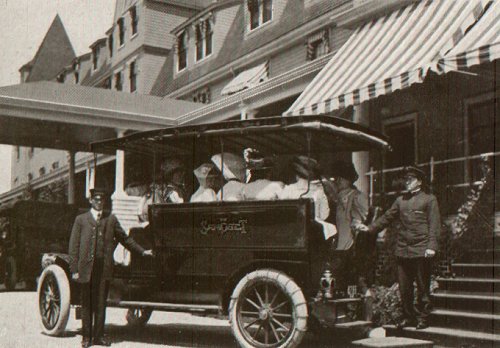
This picture gives an indication of a motor coach of the time. Taken in America in 1910.

From : http://baharris.org/historicpolandspring/Samoset/MotorCoach_1912.jpg

Tuesday, May 06, 2008

Private Albert Attwood, 8th Battalion, AIF.

Private Albert Attwood, 5330, 8th Battalion AIF won the Military Medal for his work at Broodseinde Ridge on 4th October 1917.

He enlisted in the A.I.F. on 1st February 1916 aged 26; he had been born in Kent, England. His next of kin is named as his mother, Anne Attwood from Ivy House, Orchard Street, Rainham, Kent, England.

His address at enlistment was Ardmona, Mooroopna, Victoria.

He was allocated to the 8th Battalion, 17th Reinforcements and embarked for Europe, from Melbourne on 4th April 1916 aboard HMAT A14 ‘Euripides’.

He was recommended for the Military Medal on 13th October 1917, the recommendation reads:

'During the attack on BROODSEINDE RIDGE east of YPRES on 4th October, 1917, this man showed great pluck and devotion to duty after being badly shaken by shell fire. It was mainly due to his guidance and grit that ammunition and stokes ammunition requisitions for the front line reached their destination. In spite of heavy fire this man stuck to his work continually passing over the shelled area where most casualties were inflicted. By his careful guidance fewer casualties were inflicted and the front line supply maintained.'

He was wounded in action in August 1918 and invalided back to Australia on 14th January 1919. However, before he left England on the 30th December 1918 at St. Johns Church, Tunbidge Wells, Kent, he married Miss Ethel Reynolds of 15, Thomas Street, Tunbridge Wells a 21 year old, spinster. On the wedding certificate his father is named as Horace Attwood, a Greengrocer.

Source : National Archives of Australia

Friday, May 02, 2008

The Girl I Left Behind Me by Edward Dyson

This is an interesting poem from the soldier remembering home, by the Australian Poet Edward Dyson.


THE GIRL I LEFT BEHIND ME.

I SAID: "I leave my bit of land-
In khaki they've entwined me,
I go abroad to lend a hand."
Said she: "My love, I understand.
I will be true, and though we part
A thousand years you hold my heart"-
The girl I left behind me.

I went away to fight the Huns-
No coward thought could bind me,
I sizzled n the tropic suns,
I faced the bayonets and the guns.
And when in daring deeds I shone
One little woman spurred me on-
The girl I left behind me.

Out there, in grim Gallipoli.
Hard going they assigned me,
I pricked the Turk up from the sea;
I riddled him, he punctured me;
And, bleeding in my rags, I said:
"She'll meet me somewhere if I'm dead-
The girl I left behind me.

In France we broke the German's face-
They tried with gas to blind me.
In mud we bogged from front to base,
And dirt was ours, but not disgrace.
They carved me till I couldn't stand.
Said I "Now for the Lodden, and
The girl I left behind me.

I came ashore, and struck the track;
For dust you scarce could find me.
The dear girl gave no welcome back-
Shed changed her names and state, alack!
"You've been a time, I must say, Ned,
In finishing your old war." Said
The girl I left behind me.

I flung a song up to the skies.
For battles gods designed me.
I think of Fifi's laughing eyes,
And Nami, dusk, but sweet and wise,
And chortle in my heart to find
How very far I've left behind-
The girl I left behind me