Belgian refugees were encouraged to ‘embrace’ their temporary ‘home’ land, but in 1914 the Official Committee of Belgians were evidently worried that too much ‘embracing’ and assimilation was taking place. Therefore they decided to publish a handbook of ‘suggestions and advice’ to the refugees in Britain. They warned the refugees ‘not (to) accentuate the difference between their customs and those of the British, but they stressed that:
“Every Belgian must be a good patriot….. Social and family life in Belgium is marked by friendliness, a good-natured want of ceremony, and a strict adherence to old-established habits. No one need depart from these; indeed nothing is more delightful than to find the characteristic life of Belgium reproduced in Great Britain."
Most of these characteristics of Belgian life could be found at the Earls Court Refugee Camp in London, where according to a post war report it was ‘a Belgium village in miniature, reflecting the daily life of an industrious people’. In fact, during the war over 100,000 people passed through its doors.
Thursday, May 22, 2008

Wednesday, May 21, 2008
Crime in 1916
This article appeared in the Eastbourne Gazette on 30th August 1916, reminds us that life continued on exactly the same on the home front.
Looking at the reports now, one cannot but smile! The fact that they left old underwear behind is no surprise, but to think that stealing coats or trousers might be suspicious and shirts and socks is not is amazing! Shop lifting with a pair of scissors!
“Eastbourne Shops Broken Into.
Within the past few days several robberies have been committed in Eastbourne. In some instances the thieves have walked into entrance halls with the object of stealing any valuable articles within reach: and it is necessary therefore to warn householders and servants to be on their guard. Information as to the presence in any locality of suspicious persons should be given to the police at the earliest possible moment.
On Saturday morning it was discovered that two establishments in Terminus Road had been broken into by some person or persons unknown. The thief or thieves did not use housebreaking implements but brought into requisition a pair of scissors. An outfitters shop was entered and the office was ransacked but efforts to force the safe failed. Only a small sum of money was stolen. Some shirts and socks were taken and some old underwear was left behind. So far as we can learn no coats or trousers were taken, possibly because the thief or thieves feared that the possession of new garments would bring them under suspicion. This robbery was mentioned in the Sunday newspapers and the publicity given to it will, we hope, have the effect of assisting the authorities to track the thieves.”
Looking at the reports now, one cannot but smile! The fact that they left old underwear behind is no surprise, but to think that stealing coats or trousers might be suspicious and shirts and socks is not is amazing! Shop lifting with a pair of scissors!
“Eastbourne Shops Broken Into.
Within the past few days several robberies have been committed in Eastbourne. In some instances the thieves have walked into entrance halls with the object of stealing any valuable articles within reach: and it is necessary therefore to warn householders and servants to be on their guard. Information as to the presence in any locality of suspicious persons should be given to the police at the earliest possible moment.
On Saturday morning it was discovered that two establishments in Terminus Road had been broken into by some person or persons unknown. The thief or thieves did not use housebreaking implements but brought into requisition a pair of scissors. An outfitters shop was entered and the office was ransacked but efforts to force the safe failed. Only a small sum of money was stolen. Some shirts and socks were taken and some old underwear was left behind. So far as we can learn no coats or trousers were taken, possibly because the thief or thieves feared that the possession of new garments would bring them under suspicion. This robbery was mentioned in the Sunday newspapers and the publicity given to it will, we hope, have the effect of assisting the authorities to track the thieves.”
Tuesday, May 20, 2008
Rats in Flanders
This article comes from the excellent 1st Australian Mining Corps website ‘Tunnellers’ and is a letter from the famous pre-war author Albert Dorrington to the N.Q. Register dated 21st August 1916.
I previously posted a letter from Private Wenham of 11th Battalion Royal Sussex Regiment and his experience of Rats. It is interesting how the soldiers looked to rats for an early warning of a gas attack.
"RATS IN FLANDERS
A soldier writes me from Flanders anent rats in trenches. While admitting that there are thousands running about, he has not heard of one live man who has been bitten by them. It is quite the thing to put a piece of cheese on the end of a bayonet and put rifles over the trench tops, and when through the periscope a rat is seen eating the cheese, to pull the trigger of Mr Rat. But it has been discovered that the rat could smell gas long before the men could, so to-day, as soon as the men in the trenches see the rats getting uneasy, they know, that the gas is coming and on to the helmets. Also rats eat up all decay matter, and have cut down smells to a minimum."
The 1st Australian Tunnelling Company Memorial is located on the Western Front at Hill 60 in Belgium.
I previously posted a letter from Private Wenham of 11th Battalion Royal Sussex Regiment and his experience of Rats. It is interesting how the soldiers looked to rats for an early warning of a gas attack.
"RATS IN FLANDERS
A soldier writes me from Flanders anent rats in trenches. While admitting that there are thousands running about, he has not heard of one live man who has been bitten by them. It is quite the thing to put a piece of cheese on the end of a bayonet and put rifles over the trench tops, and when through the periscope a rat is seen eating the cheese, to pull the trigger of Mr Rat. But it has been discovered that the rat could smell gas long before the men could, so to-day, as soon as the men in the trenches see the rats getting uneasy, they know, that the gas is coming and on to the helmets. Also rats eat up all decay matter, and have cut down smells to a minimum."
The 1st Australian Tunnelling Company Memorial is located on the Western Front at Hill 60 in Belgium.
Thursday, May 15, 2008
Private Francis Douglas Ernest Aloysius Asker, 8th Battalion, AIF
Private Francis Douglas Ernest Aloysius Asker, 6383, 8th Battalion, AIF was awarded the Military Medal for conspicuous gallantry and devotion to duty on 4th October 1917.
He enlisted on 14th August 1916, aged 24, his address being that of his father, W Asker, 618 Nicholson Street, North Fitzroy, Victoria
He embarked from Melbourne, Victoria, on board HMAT A14 ‘Euripides’ on 11th September 1916. He was allocated to the 8th Battalion, 20th Reinforcements.
On New Years Day 1917, he was sent to hospital sick with Bronco, Catarrh and admitted to Middlesex War Hospital on 17th January 1917. After he was discharged from hospital he had a few weeks furlough before he was allocated to No 1 Com. Depot at Perham Downs.
He rejoined the 8th Battalion on 16th September 1917 and he was recommended and awarded the Military Medal for his work on 4th October 1917. The citation reads:
'For conspicuous gallantry and devotion to duty near ZONNEBEKE east of YPRES, on 4th October, 1917, this man rushed a German Machine Gun and despite resistance killed the crew and put the gun out of action.'
He was gassed on 1st August 1918 and invalided to the U.K. 3 days later.
He returned home to Australia on 20th December 1918.
He had two brothers who both fought with the 24th Battalion, 5786 Pte. Gerald Alphonsus and 5787, Pte. Joseph Anthony, who both survived the war and returned to Australia.
He enlisted on 14th August 1916, aged 24, his address being that of his father, W Asker, 618 Nicholson Street, North Fitzroy, Victoria
He embarked from Melbourne, Victoria, on board HMAT A14 ‘Euripides’ on 11th September 1916. He was allocated to the 8th Battalion, 20th Reinforcements.
On New Years Day 1917, he was sent to hospital sick with Bronco, Catarrh and admitted to Middlesex War Hospital on 17th January 1917. After he was discharged from hospital he had a few weeks furlough before he was allocated to No 1 Com. Depot at Perham Downs.
He rejoined the 8th Battalion on 16th September 1917 and he was recommended and awarded the Military Medal for his work on 4th October 1917. The citation reads:
'For conspicuous gallantry and devotion to duty near ZONNEBEKE east of YPRES, on 4th October, 1917, this man rushed a German Machine Gun and despite resistance killed the crew and put the gun out of action.'
He was gassed on 1st August 1918 and invalided to the U.K. 3 days later.
He returned home to Australia on 20th December 1918.
He had two brothers who both fought with the 24th Battalion, 5786 Pte. Gerald Alphonsus and 5787, Pte. Joseph Anthony, who both survived the war and returned to Australia.
Wednesday, May 14, 2008
Elizabeth Macdonald
Elizabeth Macdonald (nee Morgan) along with Dr. Bruce, Medical Superintendent of the Western Hospital, Fulham, helped establish the Belgian Refugee Depot at Earl’s Court in October 1914. She was awarded the ‘Medaille de la Reine Elizabeth’ for her humanitarian work.
She died in 1951, the British Nursing Journal honoured her with the following obituary in May 1951, page 45.
“AFTER MANY MONTHS OF ILLNESS, patiently borne, Elizabeth Macdonald (nee Morgan), widow of the late Rev. D. Macdonald, passed to her rest on February 14th, 1951.
She received her training at Marylebone Infirmary, London, and after some administrative experience at the London Fever Hospital, was appointed Matron of the Northern Hospital, Winchmore Hill, London, N., an office she held with distinction for more than twenty years, and which she relinquished in 1917, on her marriage to the Rev. Duncan Macdonald, then Minister of the Established Church of Scotland, at Swinton, Berwickshire.
Elizabeth Macdonald was an able supporter of the Scheme, inaugurated in 1907, for State recognition of Fever Nurses, and ever an eager worker, she became the first Secretary of this progressive movement for the benefit of the sick; burning much midnight oil in this cause.
In 1914, in recognition of her splendid work, when she was deputed, in the First World War, to take office in an organizing capacity at the Belgian Refugee Camp at Earls Court, she received from the late King Albert of the Belgians, the Queen Elisabeth Medal (Médaille de la Reine Elizabeth) and one hundred pounds.
In her last and surprisingly legible letter, written only a few weeks before her death, alluding to her impaired sight, crumpled hand, and the loss of many dear friends, but always looking for the bright side, she remarks :
She died in 1951, the British Nursing Journal honoured her with the following obituary in May 1951, page 45.
“AFTER MANY MONTHS OF ILLNESS, patiently borne, Elizabeth Macdonald (nee Morgan), widow of the late Rev. D. Macdonald, passed to her rest on February 14th, 1951.
She received her training at Marylebone Infirmary, London, and after some administrative experience at the London Fever Hospital, was appointed Matron of the Northern Hospital, Winchmore Hill, London, N., an office she held with distinction for more than twenty years, and which she relinquished in 1917, on her marriage to the Rev. Duncan Macdonald, then Minister of the Established Church of Scotland, at Swinton, Berwickshire.
Elizabeth Macdonald was an able supporter of the Scheme, inaugurated in 1907, for State recognition of Fever Nurses, and ever an eager worker, she became the first Secretary of this progressive movement for the benefit of the sick; burning much midnight oil in this cause.
In 1914, in recognition of her splendid work, when she was deputed, in the First World War, to take office in an organizing capacity at the Belgian Refugee Camp at Earls Court, she received from the late King Albert of the Belgians, the Queen Elisabeth Medal (Médaille de la Reine Elizabeth) and one hundred pounds.
In her last and surprisingly legible letter, written only a few weeks before her death, alluding to her impaired sight, crumpled hand, and the loss of many dear friends, but always looking for the bright side, she remarks :
“However, I’m very happy here, only lonely!” How sad for her who loved life and people!
It is a great consolation to know how grateful she was end how comforted by the care and kindness bestowed on her by the Matron and Staff of the beautiful Crail Nursing Home, Fife.
We who knew her feel deeply, that in the passing of Elizabeth Macdonald’s bright and courageous soul, the world, is, indeed, the poorer."

Belgian 1914-18 Médaille de la Reine Elizabeth ( Queen Elizabeth Medal).
Awarded for humanitarian war work.
Monday, May 12, 2008
C.S.M. James Breeze, 8th Battalion, AIF.
C.S.M. James Breeze, 1345, 8th Battalion, AIF. Won the Distingushed Conduct Medal for his work at Polygon Wood on 20th September 1917.
He enlisted at the age of 24, on 21st September 1914 at Broadmeadows, his next of kin was James David Breeze, 207 Osborne Street, Williamstown, Victoria and he was previously employed as an Accountant.
On his enlistment form it said he served 5 years in the Victorian Scottish Regiment.
He was allocated to the 2nd Reinforcements of the 8th Battalion and embarked from Melbourne, Victoria, on board HMAT A46 “Clan Macgillivray” on 2nd February 1915.
He was admitted to Hospital with Dysentery 28th August 1915 and sent to Hospital in Southampton, England. He eventually re-joined the 8th Battalion on 8th August 1916.
His recommendation for the D.C.M. reads:
“During the attack on Polygon Wood near Ypres on 20th September 1917, C.S.M. Breeze did splendid work from start to finish. When some of his Officers became casualties during the advance, he took charge and led the platoons to the attack in a courageous and efficient manner. Throughout the action he showed a fine disregard for his personal safety, and handled his men with great skill and initiative.
At times when the line became disorganised through casualties he showed great ability and courage in reorganising under heavy fire.
He set a splendid example to his men throughout the action.”
He was gassed on 25th September 1917 and subsequently sent on temporary appointment to the 4th Army Musketry School. He rejoined the 8th Battalion on 29th September 1918.
He returned to Australia on 21st March 1919.
He enlisted at the age of 24, on 21st September 1914 at Broadmeadows, his next of kin was James David Breeze, 207 Osborne Street, Williamstown, Victoria and he was previously employed as an Accountant.
On his enlistment form it said he served 5 years in the Victorian Scottish Regiment.
He was allocated to the 2nd Reinforcements of the 8th Battalion and embarked from Melbourne, Victoria, on board HMAT A46 “Clan Macgillivray” on 2nd February 1915.
He was admitted to Hospital with Dysentery 28th August 1915 and sent to Hospital in Southampton, England. He eventually re-joined the 8th Battalion on 8th August 1916.
His recommendation for the D.C.M. reads:
“During the attack on Polygon Wood near Ypres on 20th September 1917, C.S.M. Breeze did splendid work from start to finish. When some of his Officers became casualties during the advance, he took charge and led the platoons to the attack in a courageous and efficient manner. Throughout the action he showed a fine disregard for his personal safety, and handled his men with great skill and initiative.
At times when the line became disorganised through casualties he showed great ability and courage in reorganising under heavy fire.
He set a splendid example to his men throughout the action.”
He was gassed on 25th September 1917 and subsequently sent on temporary appointment to the 4th Army Musketry School. He rejoined the 8th Battalion on 29th September 1918.
He returned to Australia on 21st March 1919.
Friday, May 09, 2008
Belgian Refugee removed into custody.
This article appeared in the Eastbourne Gazette on 30th August 1916. Belgian Refugees were allocated where possible to costal towns after their arrival in England, with many still staying in London. It can be read from this article that if Refugees caused undue problems where they were placed, they could be ‘sent’ to London (Earl’s Court in this case), where they would stay.
It may seem a bit harsh reading this from the 21st Century that 90 years ago, the poor man was expelled back to London for getting drunk twice, but there it is!
"Undesirable Belgian
At the Eastbourne Police Court yesterday (Tuesday) before Colonel Alexander Bowes Mein and Alderman H.W. Keay, a Belgian named Alphons Edmund Weeze, of the Refugee Camp, Earls Court, was charged with being in Eastbourne (a prohibited area) without the permission of the chief constable.
Police-constable Cooper, of the Registration Department, gave evidence to the effect that the man called at the Town Hall to see the Chief Constable whereupon he was taken into custody.
The Chief Constable stated that Weeze had previously lived in Eastbourne, but on two occasions was convicted of drunkenness, as the result of which he was expelled from the area as being undesirable. Recently the man wrote to him to ask forgiveness for his past misdeeds and to prevail if possible upon him (the Chief Constable) to allow him to remain in Eastbourne.
Defendant was fined £1, and failing to pay, was removed into custody."
It may seem a bit harsh reading this from the 21st Century that 90 years ago, the poor man was expelled back to London for getting drunk twice, but there it is!
"Undesirable Belgian
At the Eastbourne Police Court yesterday (Tuesday) before Colonel Alexander Bowes Mein and Alderman H.W. Keay, a Belgian named Alphons Edmund Weeze, of the Refugee Camp, Earls Court, was charged with being in Eastbourne (a prohibited area) without the permission of the chief constable.
Police-constable Cooper, of the Registration Department, gave evidence to the effect that the man called at the Town Hall to see the Chief Constable whereupon he was taken into custody.
The Chief Constable stated that Weeze had previously lived in Eastbourne, but on two occasions was convicted of drunkenness, as the result of which he was expelled from the area as being undesirable. Recently the man wrote to him to ask forgiveness for his past misdeeds and to prevail if possible upon him (the Chief Constable) to allow him to remain in Eastbourne.
Defendant was fined £1, and failing to pay, was removed into custody."
Thursday, May 08, 2008
Earl's Court Depot for Belgian Refugees.
After Germany invaded Belgium in 1914, refugees fled to Holland and across the channel into England. In October 1914, to deal with this major influx of refugees two Depots were opened in London, the first at Alexandra Place and the other at Earl's Court.
During the war it was estimated that over 100,000 Belgian refugees passed through the doors of Earl's Court. In a post war report about the Depot it was described as ‘a Belgium village in miniature, reflecting the daily life of an industrious people’.
This report in the British Nursing Journal dated October 23th 1914, (pages 332 & 333) describes (in the language of the time) the setting up and the organizing of the Depot during the first few weeks of its opening in 1914:-
"THE REFUGEE DEPOT AT EARL’S COURT.
The Local Government Board has done wisely in placing the organisation of the large Depots for Belgian Refugees at the Alexandra Palace, and at Earl’s Court Exhibition Buildings in the hands of the Metropolitan Asylums Board. The Board and its Medical Superintendents and Matrons are accustomed to deal with large numbers, and it takes first class organisers to introduce discipline and order (both of which are necessary for smooth working and comfort) amongst a heterogeneous crowd, more especially when it is composed of foreigners who do not understand a word of English, and who, after the harrowing experiences of the past weeks, have in a more or less dazed condition taken refuge in this country.
Down at Earl’s Court Dr. Bruce, Medical Superintendent of the Western Hospital, Fulham, and Miss L. A. Morgan, Matron of the Northern Hospital, Winchmore Hill, serene and smiling, are dealing with the problem, and bringing order out of chaos. On Wednesday evening last week the Exhibition closed, on Thursday morning the M.A.B. took possession and the same evening 400 refugees were admitted. On Sunday night over 1,700 slept there, and on Monday evening 500 more were expected. Imagine receiving, registering, classifying, and making arrangements for bathing, feeding, and sleeping this huge family, in an empty building. The bathing is done at public baths near by, and the able-bodied feed in a huge dining-room with rows upon rows of tables.
Of course, amongst such a number there are some, especially children, who need Hospital care, and a charming hospital has been arranged in the Garden Club. An oak panelled room with doors wide set on to the garden (where bright flowers are still blooming) and windows screened with fresh muslin curtains, makes an attractive ward. The brown tone of the walls is repeated in the soft coloured rugs on the beds, and the screens which harmonize with both, and the necessary touch of colour is given by the brightened flowers on the tables in the centre. In the cots are little Belgian children, many only babies, with pathetic dark eyes, and black hair, some of whom sit up in their beds and refuse to be comforted, and small wonder considering the strangeness of their surroundings, and that they have been a week on the way. In this ward also are girls, and beyond is one for men (men who lie thoroughly exhausted and tired out), needing sleep and food to enable them to face the battle of life once more.
Close by are the quarters of the Matron and nurses, who are assisted by many willing helpers from the Board’s hospitals in their off duty time.
The men sleep in the great amphitheatre. Tier upon tier, row upon row, one sees the mattresses and blankets, which at least provide warm and comfortable beds for the night till some more permanent home can be found for these poor people. Similar accommodation is provided for the women and children in the great halls.
One of the needs of the moment is for toys. Imagine a great family of children to keep happy and amused and nothing for them to play with. Only (lest some should read these words and hasten to dispatch boxes of toys) to them be sure to pay the carriage. Children’s clothes too are needed. These refugees have very few possessions, therefore let wardrobes and drawers be overhauled and all good and useful clothing which can be spared be sent to the Earl’s Court Depot at once."
During the war it was estimated that over 100,000 Belgian refugees passed through the doors of Earl's Court. In a post war report about the Depot it was described as ‘a Belgium village in miniature, reflecting the daily life of an industrious people’.
This report in the British Nursing Journal dated October 23th 1914, (pages 332 & 333) describes (in the language of the time) the setting up and the organizing of the Depot during the first few weeks of its opening in 1914:-
"THE REFUGEE DEPOT AT EARL’S COURT.
The Local Government Board has done wisely in placing the organisation of the large Depots for Belgian Refugees at the Alexandra Palace, and at Earl’s Court Exhibition Buildings in the hands of the Metropolitan Asylums Board. The Board and its Medical Superintendents and Matrons are accustomed to deal with large numbers, and it takes first class organisers to introduce discipline and order (both of which are necessary for smooth working and comfort) amongst a heterogeneous crowd, more especially when it is composed of foreigners who do not understand a word of English, and who, after the harrowing experiences of the past weeks, have in a more or less dazed condition taken refuge in this country.
Down at Earl’s Court Dr. Bruce, Medical Superintendent of the Western Hospital, Fulham, and Miss L. A. Morgan, Matron of the Northern Hospital, Winchmore Hill, serene and smiling, are dealing with the problem, and bringing order out of chaos. On Wednesday evening last week the Exhibition closed, on Thursday morning the M.A.B. took possession and the same evening 400 refugees were admitted. On Sunday night over 1,700 slept there, and on Monday evening 500 more were expected. Imagine receiving, registering, classifying, and making arrangements for bathing, feeding, and sleeping this huge family, in an empty building. The bathing is done at public baths near by, and the able-bodied feed in a huge dining-room with rows upon rows of tables.
Of course, amongst such a number there are some, especially children, who need Hospital care, and a charming hospital has been arranged in the Garden Club. An oak panelled room with doors wide set on to the garden (where bright flowers are still blooming) and windows screened with fresh muslin curtains, makes an attractive ward. The brown tone of the walls is repeated in the soft coloured rugs on the beds, and the screens which harmonize with both, and the necessary touch of colour is given by the brightened flowers on the tables in the centre. In the cots are little Belgian children, many only babies, with pathetic dark eyes, and black hair, some of whom sit up in their beds and refuse to be comforted, and small wonder considering the strangeness of their surroundings, and that they have been a week on the way. In this ward also are girls, and beyond is one for men (men who lie thoroughly exhausted and tired out), needing sleep and food to enable them to face the battle of life once more.
Close by are the quarters of the Matron and nurses, who are assisted by many willing helpers from the Board’s hospitals in their off duty time.
The men sleep in the great amphitheatre. Tier upon tier, row upon row, one sees the mattresses and blankets, which at least provide warm and comfortable beds for the night till some more permanent home can be found for these poor people. Similar accommodation is provided for the women and children in the great halls.
One of the needs of the moment is for toys. Imagine a great family of children to keep happy and amused and nothing for them to play with. Only (lest some should read these words and hasten to dispatch boxes of toys) to them be sure to pay the carriage. Children’s clothes too are needed. These refugees have very few possessions, therefore let wardrobes and drawers be overhauled and all good and useful clothing which can be spared be sent to the Earl’s Court Depot at once."
Wednesday, May 07, 2008
Motor Coach Trade in the War.
This article appeared in the Eastbourne Gazette on 30th August 1916. Petrol was in short supply as the army needed most supplies, this meant that the motor coach tourist business was severely hit, which in turn affected most seaside town’s tourist economy.
The fact that the army hierarchy was quite willing to use supplies for its own ends does not endear itself to the Eastbourne Gazette’s editors.
"Motor Coaches
Request For Extension Of Time
The motor coaches are such an important feature at Eastbourne and other seaside resorts that if they are to cease running great loss and hardship must be caused to the proprietors and their employees. We hope, therefore, that every possible effort will be made to secure just and considerate treatment for a business in which a large amount of capital is invested and we understand that the proprietors are prepared to reduce their consumption of petrol to such an extent that no question of interference with military supplies can arise.
This is surely the limit. Writing from Hampshire to a firm of motor coach owners of Eastbourne, a gentleman who proposed to go for a long trip writes: “I am sorry you have had to cancel the tour, but I shall feel it less than others. I expect as I am going on tour with an army officer who is able to get petrol, and thus consider myself extremely fortunate in the days!”"

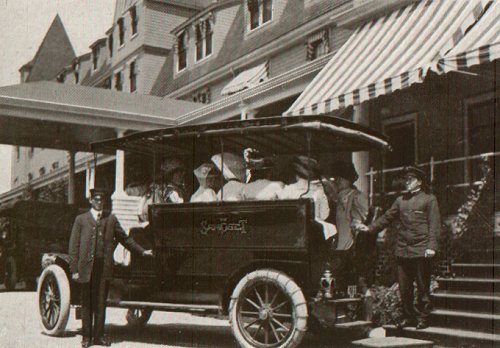
This picture gives an indication of a motor coach of the time. Taken in America in 1910.
From : http://baharris.org/historicpolandspring/Samoset/MotorCoach_1912.jpg
The fact that the army hierarchy was quite willing to use supplies for its own ends does not endear itself to the Eastbourne Gazette’s editors.
"Motor Coaches
Request For Extension Of Time
The motor coaches are such an important feature at Eastbourne and other seaside resorts that if they are to cease running great loss and hardship must be caused to the proprietors and their employees. We hope, therefore, that every possible effort will be made to secure just and considerate treatment for a business in which a large amount of capital is invested and we understand that the proprietors are prepared to reduce their consumption of petrol to such an extent that no question of interference with military supplies can arise.
This is surely the limit. Writing from Hampshire to a firm of motor coach owners of Eastbourne, a gentleman who proposed to go for a long trip writes: “I am sorry you have had to cancel the tour, but I shall feel it less than others. I expect as I am going on tour with an army officer who is able to get petrol, and thus consider myself extremely fortunate in the days!”"
This picture gives an indication of a motor coach of the time. Taken in America in 1910.
From : http://baharris.org/historicpolandspring/Samoset/MotorCoach_1912.jpg
Tuesday, May 06, 2008
Private Albert Attwood, 8th Battalion, AIF.
Private Albert Attwood, 5330, 8th Battalion AIF won the Military Medal for his work at Broodseinde Ridge on 4th October 1917.
He enlisted in the A.I.F. on 1st February 1916 aged 26; he had been born in Kent, England. His next of kin is named as his mother, Anne Attwood from Ivy House, Orchard Street, Rainham, Kent, England.
His address at enlistment was Ardmona, Mooroopna, Victoria.
He was allocated to the 8th Battalion, 17th Reinforcements and embarked for Europe, from Melbourne on 4th April 1916 aboard HMAT A14 ‘Euripides’.
He was recommended for the Military Medal on 13th October 1917, the recommendation reads:
'During the attack on BROODSEINDE RIDGE east of YPRES on 4th October, 1917, this man showed great pluck and devotion to duty after being badly shaken by shell fire. It was mainly due to his guidance and grit that ammunition and stokes ammunition requisitions for the front line reached their destination. In spite of heavy fire this man stuck to his work continually passing over the shelled area where most casualties were inflicted. By his careful guidance fewer casualties were inflicted and the front line supply maintained.'
He was wounded in action in August 1918 and invalided back to Australia on 14th January 1919. However, before he left England on the 30th December 1918 at St. Johns Church, Tunbidge Wells, Kent, he married Miss Ethel Reynolds of 15, Thomas Street, Tunbridge Wells a 21 year old, spinster. On the wedding certificate his father is named as Horace Attwood, a Greengrocer.
Source : National Archives of Australia
He enlisted in the A.I.F. on 1st February 1916 aged 26; he had been born in Kent, England. His next of kin is named as his mother, Anne Attwood from Ivy House, Orchard Street, Rainham, Kent, England.
His address at enlistment was Ardmona, Mooroopna, Victoria.
He was allocated to the 8th Battalion, 17th Reinforcements and embarked for Europe, from Melbourne on 4th April 1916 aboard HMAT A14 ‘Euripides’.
He was recommended for the Military Medal on 13th October 1917, the recommendation reads:
'During the attack on BROODSEINDE RIDGE east of YPRES on 4th October, 1917, this man showed great pluck and devotion to duty after being badly shaken by shell fire. It was mainly due to his guidance and grit that ammunition and stokes ammunition requisitions for the front line reached their destination. In spite of heavy fire this man stuck to his work continually passing over the shelled area where most casualties were inflicted. By his careful guidance fewer casualties were inflicted and the front line supply maintained.'
He was wounded in action in August 1918 and invalided back to Australia on 14th January 1919. However, before he left England on the 30th December 1918 at St. Johns Church, Tunbidge Wells, Kent, he married Miss Ethel Reynolds of 15, Thomas Street, Tunbridge Wells a 21 year old, spinster. On the wedding certificate his father is named as Horace Attwood, a Greengrocer.
Source : National Archives of Australia
Friday, May 02, 2008
The Girl I Left Behind Me by Edward Dyson
This is an interesting poem from the soldier remembering home, by the Australian Poet Edward Dyson.
THE GIRL I LEFT BEHIND ME.
I SAID: "I leave my bit of land-
In khaki they've entwined me,
I go abroad to lend a hand."
Said she: "My love, I understand.
I will be true, and though we part
A thousand years you hold my heart"-
The girl I left behind me.
I went away to fight the Huns-
No coward thought could bind me,
I sizzled n the tropic suns,
I faced the bayonets and the guns.
And when in daring deeds I shone
One little woman spurred me on-
The girl I left behind me.
Out there, in grim Gallipoli.
Hard going they assigned me,
I pricked the Turk up from the sea;
I riddled him, he punctured me;
And, bleeding in my rags, I said:
"She'll meet me somewhere if I'm dead-
The girl I left behind me.
In France we broke the German's face-
They tried with gas to blind me.
In mud we bogged from front to base,
And dirt was ours, but not disgrace.
They carved me till I couldn't stand.
Said I "Now for the Lodden, and
The girl I left behind me.
I came ashore, and struck the track;
For dust you scarce could find me.
The dear girl gave no welcome back-
Shed changed her names and state, alack!
"You've been a time, I must say, Ned,
In finishing your old war." Said
The girl I left behind me.
I flung a song up to the skies.
For battles gods designed me.
I think of Fifi's laughing eyes,
And Nami, dusk, but sweet and wise,
And chortle in my heart to find
How very far I've left behind-
The girl I left behind me
THE GIRL I LEFT BEHIND ME.
I SAID: "I leave my bit of land-
In khaki they've entwined me,
I go abroad to lend a hand."
Said she: "My love, I understand.
I will be true, and though we part
A thousand years you hold my heart"-
The girl I left behind me.
I went away to fight the Huns-
No coward thought could bind me,
I sizzled n the tropic suns,
I faced the bayonets and the guns.
And when in daring deeds I shone
One little woman spurred me on-
The girl I left behind me.
Out there, in grim Gallipoli.
Hard going they assigned me,
I pricked the Turk up from the sea;
I riddled him, he punctured me;
And, bleeding in my rags, I said:
"She'll meet me somewhere if I'm dead-
The girl I left behind me.
In France we broke the German's face-
They tried with gas to blind me.
In mud we bogged from front to base,
And dirt was ours, but not disgrace.
They carved me till I couldn't stand.
Said I "Now for the Lodden, and
The girl I left behind me.
I came ashore, and struck the track;
For dust you scarce could find me.
The dear girl gave no welcome back-
Shed changed her names and state, alack!
"You've been a time, I must say, Ned,
In finishing your old war." Said
The girl I left behind me.
I flung a song up to the skies.
For battles gods designed me.
I think of Fifi's laughing eyes,
And Nami, dusk, but sweet and wise,
And chortle in my heart to find
How very far I've left behind-
The girl I left behind me
Subscribe to:
Posts (Atom)